

As technology reshapes learning landscapes (quite dramatically, in fact!), educators must embrace tools like Virtual Reality (VR) – the game-changer sparking curiosity through immersive student journeys. VR doesn’t just dazzle; it dismantles barriers, offering equal access to 3D simulations where learners dissect virtual frogs or walk Mars’ surface alongside classmates worldwide. For example, imagine a VR Field Trip: no expensive gear needed, just pure equitable magic turning smartphones into portals. Want proof that engaged students lead to better outcomes? This is where VR transforms “boring” into “let’s replay that simulation!” while secretly wiring brains for STEM success and improved learning outcomes.
Designing Immersive Learning with Virtual Reality
When implementing Virtual Reality in Education: How VR Enhances Engagement, Accessibility, and STEM Learning, pedagogical and instructional design become non-negotiable foundations. These frameworks transform VR from flashy technology into targeted learning tools shaped by learning objectives and hardware. Therefore, every VR journey needs meticulous planning to directly serve lesson goals – whether training nurses in emergency protocols or engineers in 3D modeling principles.
Following this focus:
- Develop learner personas through surveys and performance analysis.
- Identify accessibility needs like captioning controls and gesture alternatives.
- Design adjustable difficulty levels addressing different academic backgrounds.
Furthermore, smartphone-compatible VR tools remove headset dependence – an accessibility breakthrough, letting rural students join city peers in virtual STEM labs via devices they already own. This strategic user-centered design approach builds inclusive ecosystems where learners with mobility restrictions can dissect virtual cadavers as effectively as their peers through controller-free gaze navigation.
While budget constraints remain, prioritizing high-impact VR tools (think 360° video tours over full simulations) and measuring ROI (improved quiz scores x development hours) helps educators demonstrate program effectiveness to stakeholders. By anchoring decisions to these design principles, instructors create VR content that survives software updates and evolving student needs – true versatility we’ll explore next through diverse implementation models.
Virtual Reality Applications Across Diverse Educational Settings
Virtual reality has become a transformative technology in STEM education, offering immersive 3D Modeling and lifelike Simulations. By utilizing VR simulations to visualize complex phenomena, such as molecular structures or climate patterns, that are typically displayed abstractly in textbooks, learners achieve a concrete understanding via hands-on interactions; picture dissecting holographic frogs alongside international classmates!
Furthermore, VR empowers deeper comprehension through interactive data visualization. Imagine:
- Exploring the intricate details of circulatory systems using interactive Digital Science Lab environments.
- Manipulating base pairs by navigating through enlarged DNA strands in real-time simulations.
- Collaborating within virtual engineering workshops to construct prototype spacecraft.
However, the capability of VR extends far beyond only STEM. Beyond STEM classrooms, virtual field trips foster cultural competency. For language arts education, VR enhances cultural understanding and language acquisition. Imagine students taking virtual tours of a bustling mercado during Spanish lessons, enhancing their learning. Historical empathy develops when learners, taking on the role of protesters, experience Civil Rights marches firsthand. Ultimately, physical education can incorporate VR, with students engaging in virtual snowboarding lessons and practically applying physics principles through virtual balance and velocity experiments.
A Day With VR Education
9 am: Examine geological formations with 3D Models of tectonic plates.
11 am: Engage in virtual negotiations at Versailles for French and History.
2 pm: Evaluate structural integrity by testing designs against simulated earthquakes.
This inherent versatility extends even further, reaching into art education. Students might design or sculpt magnificent virtual monuments, simultaneously discussing the relevant historical contexts. Through VR, teachers can introduce historical empathy by having students experience culturally immersive VR scenarios. These include experiences like exploring Ancient Egypt, allowing them to understand and appreciate past civilizations. Through thoughtful integration across the curriculum, educators unlock the full potential of VR, making any subject tangible, safe to explore, and inherently collaborative for next-generation minds.
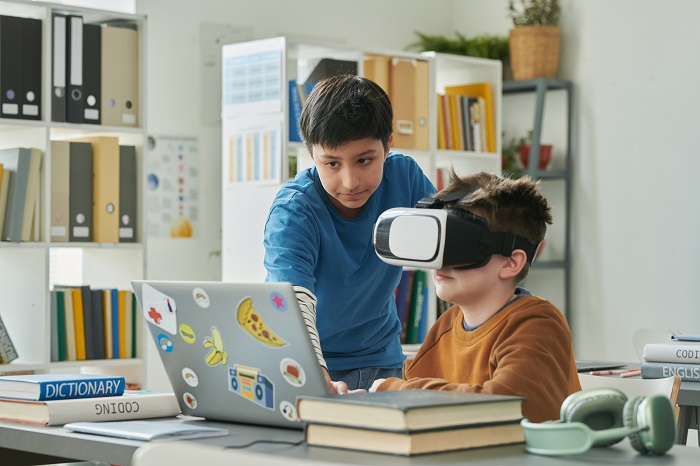
Using Virtual Reality to Build Equity in Education
There is one undeniable benefit Virtual Reality in Education delivers straight out of the box; solving resource imbalances that hold schools back. Students in poorly funded districts now conduct experiments through lifelike virtual lab simulations—no physical equipment required. Suddenly, chemistry reactions happen safely on screens, not just in privileged classrooms.
This breakthrough makes experiential learning accessible even where budgets previously blocked it. Learners who couldn’t afford field trips to NASA facilities explore Mars craters from their desks. Financial barriers? VR flips them into history lessons. However, its superpower lies deeper: fostering STEM diversity. Students with mobility impairments manipulate digital DNA strands through adaptive controllers. Those with hearing challenges get closed captioning built into geology simulations.
Why does this inclusivity matter? VR’s immersive features, like 3D visualizations and interactive quizzes, engage kinesthetic, auditory, and visual learners simultaneously. Text-to-speech narration and haptic feedback further erase learning disparities. Tools like Nearpod VR Field Trips demonstrate this beautifully, offering equitable virtual explorations from Egyptian pyramids to coral reefs—democratizing access through a smartphone app.
The outcome: schools crafting truly inclusive ecosystems where every student builds skills for tomorrow’s STEM careers. No permission slips are required—just pure curiosity powered by equity-focused innovation.
Read More : From Features to Benefits: Understanding Learning Management Systems (LMS) in Education
Future of Learning with VR
Virtual Reality in Education isn’t just changing STEM fields—it’s transforming how we prepare curious minds. Therefore, staying current with VR advancements remains critical for school districts seeking immersive learning opportunities through enhanced hardware and software.
Not only do VR advancements boost engagement, but they also expand practical career preparation—students gain hands-on problem-solving skills that bridge classroom theory and workplace demands. Think virtual engineering simulations today translate to real-world innovation tomorrow.
Furthermore, schools can no longer ignore this tech-driven shift. By embracing VR in STEM curriculum design, educators lay the groundwork for accessible, adaptive lessons that serve diverse learners through customizable experiences. They already prove their value by turning abstract concepts into tangible 3D interactions.
As VR evolves alongside Augmented and Mixed Reality technologies, classrooms will empower students to explore DNA sequences as effortlessly as distant galaxies. These tools don’t just educate; they spark the inventive thinking needed to solve tomorrow’s challenges through today’s curiosity.