

Augmented Reality (AR) is dynamically transforming modern education systems, creating immersive experiences that bridge classroom learning with interactive engagement. By seamlessly integrating three-dimensional digital content into physical environments, AR enables tailored educational pathways that traditional textbooks can’t duplicate. Imagine students manipulating scaled 3D models of molecular structures or observing historical artifacts from all angles – these immersive tools foster deeper understanding while maintaining relevance to curriculum standards.
The adoption of augmented reality in classrooms is accelerating globally, with educators reporting a significant increase in student participation when using AR tools. This shift goes beyond mere novelty. By turning abstract concepts into tangible interactions, AR helps learners grasp complex topics organically.
Practical Ways Augmented Reality Can Be Applied in Education
The transformative potential of augmented reality in education reaches every corner of learning. Transforming learning with Augmented Reality begins in classrooms where textbooks become portals to interactive 3D models. Students scan static diagrams, revealing animated molecular structures that rotate and react to touch – suddenly, organic chemistry becomes as engaging as a video game.
But AR’s magic extends beyond physical classrooms! Augmented worksheets allow learners struggling with trigonometry at home to scan problems with an app, triggering step-by-step holographic guides projected onto their desks. This hands-on approach mirrors having a virtual tutor on demand, bridging textbook theory with tangible understanding.
For technical training where equipment risks exist, AR creates safe simulations where engineering students assemble hydraulic systems digitally first – errors trigger visual alerts, not oil spills. Educators using AR labs report safety protocol mastery faster compared to traditional methods. The technology’s secret weapon? Spatial computing overlays transform abstract concepts like electromagnetic fields into glowing, interactive 3D landscapes students manipulate like clay.
Special education sees breakthroughs through personalized AR modules. Nonverbal students communicate via gesture-activated visual dictionaries, while those with mobility challenges explore virtual field trips through ancient Rome via tablet cameras. Unlike textbook learning’s rigid pace, AR adapts content complexity based on real-time performance – quickens animations for accelerated students and adds sensory cues for those needing reinforcement.
Consider these implementations demonstrating AR’s educational versatility:
- Physics instructors projecting force diagrams over real pulley systems during experiments
- History students holding museum-grade artifact replicas through classroom table projections
- Medical trainees practicing IV insertion through mixed-reality patient simulations with real-time vital feedback
The technology proves particularly valuable for STEM subjects, where AR transforms abstract equations into tactile 3D constructions. With such diverse applications already revolutionizing classrooms globally, the true advantages of implementing AR become clear. The next wave of educators won’t just present information – they’ll stage educational experiences where every desk becomes a gateway to alternate dimensions of learning.
Main Advantages of Using Augmented Reality for Education
Augmented Reality brings transformational benefits to modern education, creating enhanced experiences for teachers and learners alike. By overlaying digital content over real environments, this technology fundamentally improves student engagement through immersive 3D simulations. A chemistry class dissolves into molecular explorations where learners spin and combine virtual elements – suddenly, covalent bonding becomes a tactile reality rather than textbook theory.
Building on this enhanced engagement, augmented reality achieves unparalleled clarity and improves understanding. Complex mathematical principles transform into interactive models students manipulate using hand gestures – parabolas stretching responsively as coefficients adjust. This visual approach reduces cognitive load, helping educators report better comprehension compared to traditional methods.
Beyond improved understanding, AR enables personalized learning through adaptive algorithms that assess individual responses in real time:
- Adjust pacing: Slows rotations of 3D models for visual learners needing longer observation
- Modify difficulty: Presents advanced circuit diagrams when students master parallel resistor calculations
- Alternative formats: Swaps text explanations for spoken narration based on learning preferences
Complementing personalized learning, students interact with history through virtual reenactment battles where they strategize troop movements, earning points for historical accuracy. These gamified experiences motivate learners intrinsically.
Notably, this revolution remains accessible – most implementations require only modern smartphones rather than costly lab equipment. Schools deploy augmented field trips via mobile devices instead of organizing expensive location visits.
In summary, Augmented Reality learning offers three decisive advantages over traditional methods:
- Increased information retention through multisensory experiences
- Adaptive content addressing multiple learning modalities
- Practical implementation minimizing institutional budgets
However, maximizing these benefits requires carefully overcoming technical integration hurdles – challenges we analyze next for successful AR adoption.
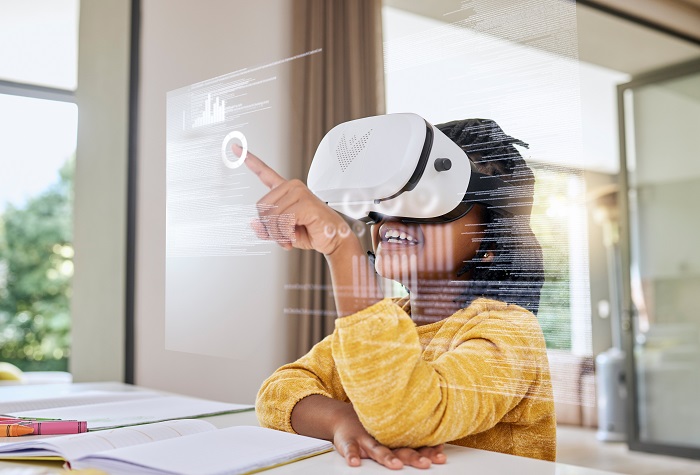
Effectively Managing the Challenges for Augmented Reality in Education
Transforming learning with augmented reality requires addressing practical obstacles alongside its promise. Integrating AR demands advanced hardware like smart glasses and robust software platforms; schools lacking IT infrastructure may struggle with these technical challenges without external support.
The scarcity of subject-specific content compounds these issues – imagine trying to visualize quantum physics through AR only to find cartoonish models that lack academic rigor. To mitigate this, institutions can:
- Collaborate with AR development companies to build curriculum-aligned modules
- Adopt cloud-based platforms that bypass costly hardware upgrades
- Run pilot programs demonstrating improved engagement metrics to skeptical educators
Resistance to technology adoption remains significant. Yet, targeted training sessions and success stories from early adopters gradually shift perspectives. User-centered design bridges this gap: when AR tools undergo usability testing with both instructors and learners, the final products align with actual classroom dynamics far better than corporate-developed solutions.
Read More : Virtual Reality in Education: How VR Enhances Engagement, Accessibility, and Learning Outcomes
Embracing Augmented Reality for a Better Learning Environment
If you’re still relying on traditional teaching methods, consider this: Augmented Reality (AR) is revolutionizing learning by making education more engaging, interactive, and accessible. Your curriculum gains unprecedented Enhanced Engagement capabilities as learners manipulate 3D models in physics and embark on virtual history quests – providing proof that understanding deepens when multisensory participation replaces rote memorization.
These shifts aren’t merely incremental; they rewrite educational psychology. Through personalized learning algorithms, AR ensures that no student gets left behind by responding to individual progress and learning disabilities. As augmented reality continues merging AI adaptability with immersive interfaces, transforming learning with augmented reality becomes more than a concept – it’s the new standard.
Ready to lead this change? Explore scalable AR solutions tailored for your institution.